

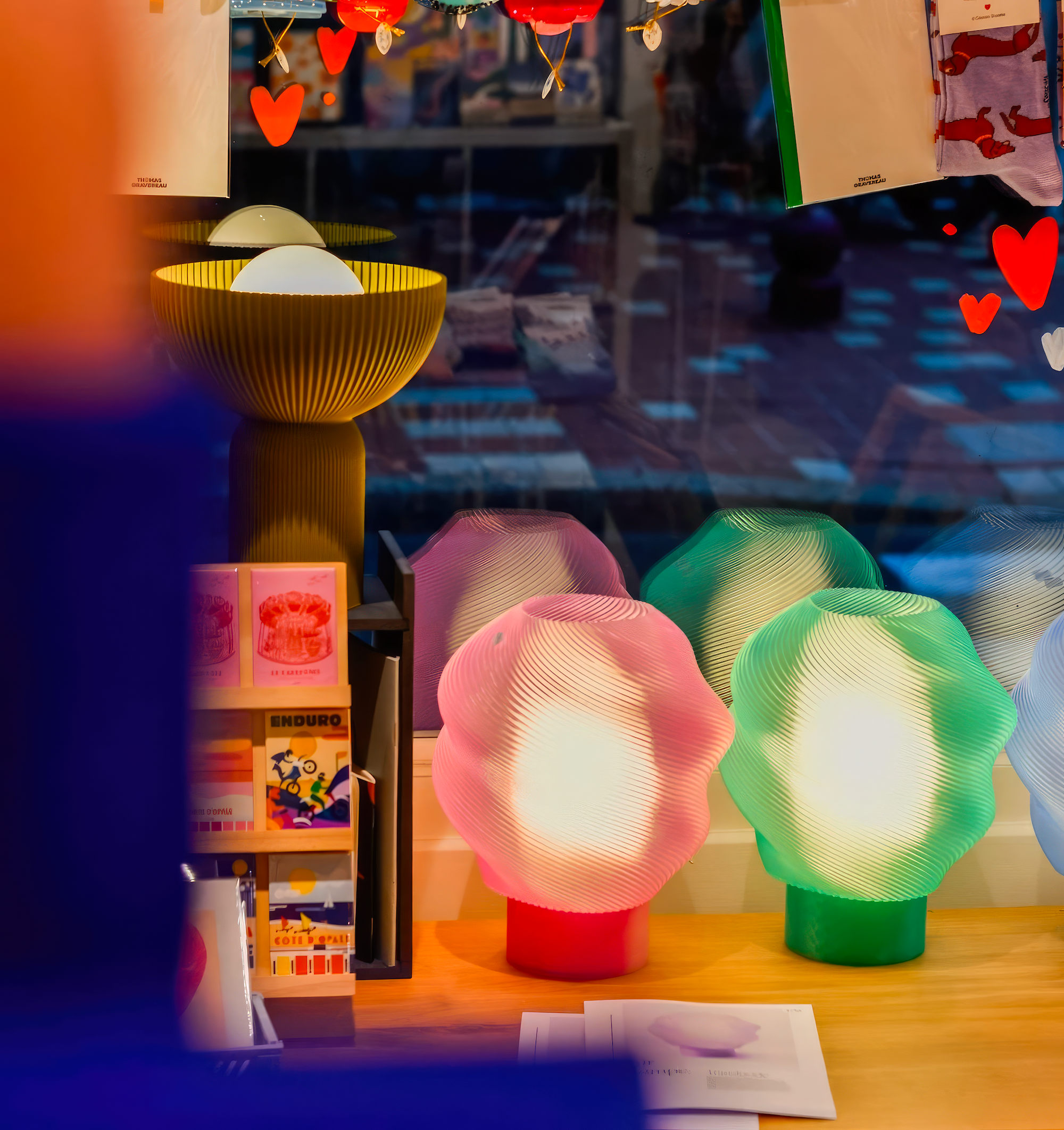
All PRZ creations — lamps, wall lights, vases, and planters — are 3D printed using a material called PLA. This is at the heart of our eco-design approach, and it's also the most common question we get at the workshop: "what exactly is this corn-based plastic?" Here's a simple and honest answer, from people who melt it every day.
A plastic that grows in the fields
PLA stands for polylactic acid. Unlike conventional plastics (ABS, polypropylene, PVC…) made from petroleum, PLA is produced from renewable plant resources — primarily corn starch, sometimes sugarcane or beet. The principle: starch is converted into sugar, sugar is fermented into lactic acid (the same as in our muscles or yogurt), then polymerized to become a solid, workable material.
Why is it more eco-friendly than petroleum-based plastic?
Three concrete reasons. First, the resource is renewable: corn grows back every year, while oil takes millions of years to form. Second, its production emits significantly less CO2 than that of petroleum plastics — the plants used to produce it actually capture carbon as they grow. Finally, PLA is biodegradable under industrial composting conditions: it decomposes in a few months at controlled temperatures and humidity, whereas conventional plastic persists for centuries.
Let's be honest: PLA is not magic
At PRZ, we prefer transparency to greenwashing. PLA does not degrade in your garden or in the ocean: it requires the conditions of an industrial composter. It remains a material to be used for durable objects, not for disposables. This is exactly our philosophy: a lamp or a vase that you keep for years, made to order, without overproduction. The ecological sense of PLA comes into its own when added to a lean model — local production, zero stock, zero unsold items.
A material perfectly suited for light
If we chose PLA for our luminaires, it's not just for its environmental footprint. Slightly translucent in light shades, it diffuses a soft and warm light without glare — this is what gives their ambiance to Air, Perl, or Kova lamps. Printed layer by layer, it reveals unique striated textures that catch the light. And it is worked at reasonable temperatures, which also reduces the energy consumed during manufacturing.
How to care for a PLA object?
It's simple: a soft cloth or a rinse with clear water is enough. Two precautions: no dishwasher and no prolonged exposure to direct sunlight behind a window (PLA doesn't like high heat — above 50-60 °C, it can deform). In a normal interior, a PLA object will stay with you without complaint for years. Our lamps use LED bulbs, which generate very little heat: no worries there.
In summary
PLA is a plant-based, renewable, low-carbon plastic, perfect for durable decorative objects and soft light — provided it is used intelligently, in lean and local production. This is the gamble of our workshop in Anglet, in the Basque Country. To see it in person: discover our bioplastic creations, or read how our 3D printed lamps are made, step by step.
Share:
How Our 3D-Printed Lamps Are Made
Quelle lampe de chevet choisir ? Le guide complet